“Amir Ahmadi’s compositions bring together elements of the Persian musical tradition with influences from contemporary European music. Microtonal structures form the foundation of a sound world that expands established ways of listening without ever alienating the listener. Rather than staging a contrast between two musical worlds, Ahmadi creates music in which both traditions naturally and effortlessly converge.” — Jazzfun.de (translation from German)
As a composer and pianist, Amir’s exploration of different musical languages has shaped a highly personal approach to his work. Born in Ahvaz, Iran, and based in Vienna, Austria, Amir Ahmadi initially trained as a mechanical engineer before going on to study composition and jazz piano in Austria.
A central focus of Amir’s artistic work is microtonality, particularly in relation to Persian Dastgah and Maqam music. In this context, he has developed a distinctive tuning system, which he incorporates into his compositions using the Claviton—a microtonal keyboard with 31 keys per octave, designed by Georg Vogel.
In 2024, Amir founded Trio Terrea, incorporating his approach to microtonality with fragments of Persian musical vocabulary and elements of modern music into his compositions, which eventually led to the trio’s debut album Raz, released by the Swiss label Unit Records in 2026. The trio has since appeared at numerous venues and festivals.
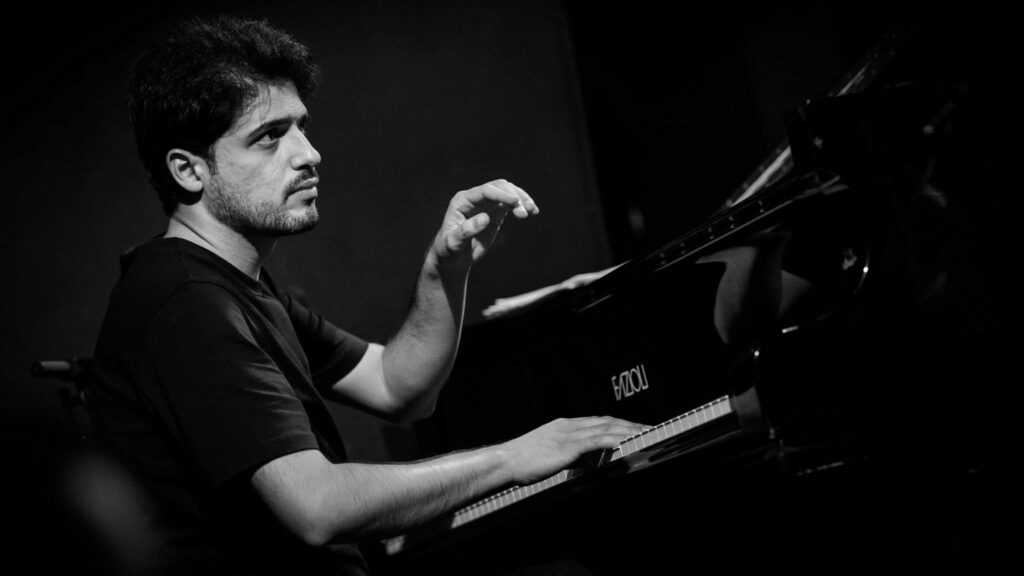
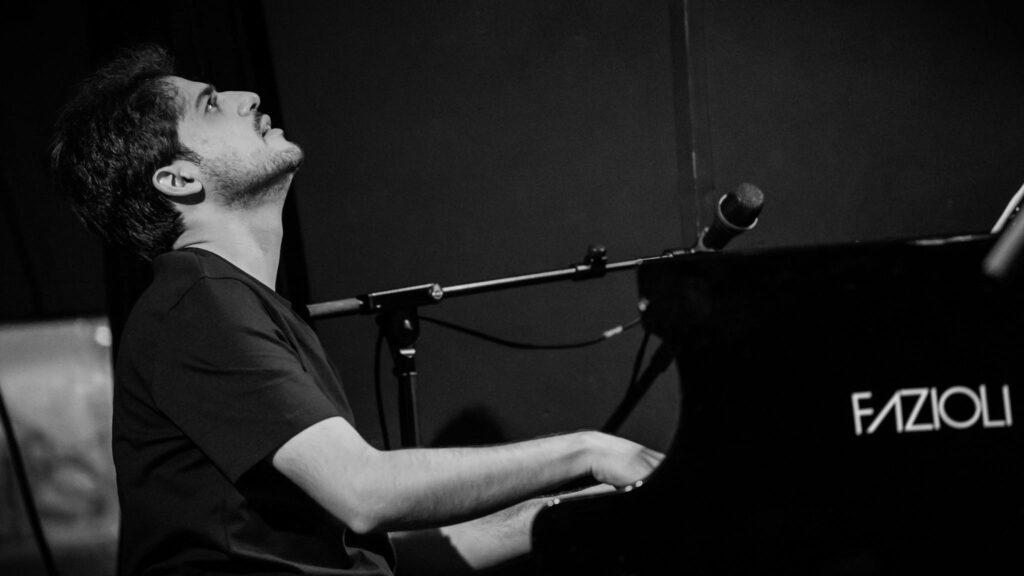
Amir has presented his work on microtonality at numerous symposia and institutions, including the Berlin University of the Arts, Akademie der Künste Berlin, the GMTH in Basel, Mikrotöne – Small is Beautiful in Salzburg, and Microtonal Village in New York.
His artistic work has been recognized with several awards and grants, including the Staatsstipendium for Composition (2024) and the Startstipendium (2022), both awarded by the Austrian Ministry of Culture. He also received the GMTH Aufsatzwettbewerb Prize for his essay on tuning systems in Iranian music.
Amir has written works for various ensembles, including the Anton Bruckner University Orchestra, Ensemble Resonanz, Janus Ensemble, and airborne extended. He has also worked in scenic music, composing a music theatre piece in 2020 based on the poetry of Forough Farrokhzad. In 2019, he initiated Bauhaus tanzt, a dance project in which he performed John Cage’s Sonatas and Interludes, touring with the production across Europe.
As a pianist and keyboardist, Amir also collaborates with various ensembles, including Kurdophone, with whom he has performed at venues and festivals such as the Elbphilharmonie, Musikverein Wien, and Carinthischer Sommer. He is also active as an organizer and co-founder of Studio Fugu, an association dedicated to interdisciplinary art projects.
Amir’s work reflects an ongoing interest in bringing different musical traditions and contemporary approaches into dialogue. Through his compositions and performances, he combines contemporary, jazz, and traditional influences, with microtonality remaining central to his artistic expression.